
Columns by John

John Brown has been a wine and food columnist in West Virginia since the 1980’s. His regular columns appear in the Charleston (WV) Gazette-Mail under the title Vines & Vittles.

Charleston: a good place to ride out the pandemic

If you’re a food and wine junkie like me, this pandemic has really altered your lifestyle. My wife and I enjoy eating in and opening a good bottle of wine at home more than just about anybody, but we miss those restaurant or bar date nights where we can let someone else prepare our meal and serve us our beverages.

However, visiting restaurants or bars now, though, is not nearly as much fun as in the past. Social distancing, limited seating arrangements and facial coverings – while understandably necessary, present impediments and obstacles to having a relaxing and enjoyable dining experience. And if you are in the geezer demographic or are physically compromised, the fear of contracting the virus in public places – like restaurants -is an even more inhibiting factor.

But guess what? I have come to the conclusion that Charleston is a pretty good place to shelter in place for a while, especially for foodies and wine geeks. Why? Well, in our little corner of the world, we are blessed to have access to purveyors who provide us with some of freshest and highest quality victuals you can find just about anywhere in this region of the good old US of A.

image

Let’s start with the basics like bread, vegetables and proteins.

I have travelled in some of the most famous epicurean capitals of Europe where the local bread is spoken of reverentially, but none of those bakeries is any more accomplished than Charleston Bread located on North Capitol Street in our fair city. Their baguettes, ciabatta, multigrain, honey whole wheat, sour dough and other breads are delicious while the salt, pepper and olive oil focaccia is otherworldly. They even crank out delicious and varying styles of pasta noodles you can buy right there at the bakery. Oh, and the pastries are the real deal too, especially the cakes, brownies, cinnamon rolls and biscotti.

But man does not live by bread alone, right? If you love to consume locally grown produce, you’ve been to the Capitol Market’s outdoor farmer’s market to buy tomatoes, fresh corn, beans, peppers and just about anything else that grows in the fertile soil around these parts. Just last week, I bought a bushel of locally grown red peppers which I promptly roasted, peeled (and packed with basil) and then put in the freezer for use as a taste of summer in the dead of next winter. Inside the market, you will also find excellent produce at the Purple Onion.

Of course, the Capitol Market also features a wine shop where you can pick up a few bottles of vino to accompany your home cooked feast. I recently purchased a bottle of 2018 Au Bon Climat Chardonnay (see the description below) to accompany a home made dish of linguine (from Charleston Bread) with broccoli and Italian sausage in a béchamel sauce. Also, in the market, you’ll find a great selection of fresh meat at Johnny’s. Everything from chicken to just about any cut of steak and pork is available or can be cut for you while you wait.

And if you’re a seafood lover, you’ve probably been to General Steak and Seafood (formerly known Joe’s Fish Market) on Quarrier Street in downtown Charleston. This place is an institution and the home of the freshest seafood you’ll find just about anywhere. They even hot smoke whole salmon filets over apple wood! And in the past several months, the business has added meat to the array of fresh goodies – hence the name change. Brothers Joe and Robin Harmon have owned the place for years and remain in charge. The new butcher shop is amazing! I’ve ordered (and grilled) Berkshire pork chops, prime filet, dry-aged steaks and free-range chickens.

So, while all of us are doing our level best to survive these weird times in good health, we’re very fortunate to have exceptional businesses that provide us the opportunity to purchase and prepare quality meals in the safety of our own homes – and sip a little wine too. It certainly makes this pandemic more tolerable!
***

2018 Au Bon Climat Chardonnay ($24) From Santa Barbara County, this wine is Burgundian in style, but with California ripeness and intensity – a chardonnay of structure and restraint melded with richness. In the glass, a touch of vanilla enhances the ripe apple flavors to produce a very full, but balanced wine. The wine was a very compatible pairing with the linguine, broccoli and Italian sausage meal we enjoyed in our semi-isolation.

John Brown is also a novelist.  His latest book is “Augie’s World” which is a sequel to his debut novel, Augie’s War. You can find out more about his novels at wordsbyjohnbrown.com.


Summertime Red Wine

Even though temperatures are approaching meteorological hell, I refuse to give up the pleasures of sipping red wine with the foods of summer.

Sure, I drink more refreshing whites and rose’s this time of year than I do of those purple monsters, but I still open and enjoy red wines. I just modify that old (and hackneyed) adage that red wine should be served at room temperature. Of course, when the Medieval wine snob who offered that advice did so, room temperature was about 50 degrees Fahrenheit.

I simply put my red wine in the refrigerator for about a half hour before opening it and then keep it in an ice bucket after pouring a glass or two. I do, though, usually prefer lighter styled reds such as pinot noir and Valpolicella this time of year. The beauty of these two varietals is that – while they are not full-bodied like cabernet or zinfandel- they do stand up to and pair well with picnic foods like sausages, ribs and foods with spicy heat.

Pinot noir like those produced by Elouan and Erath from Oregon, J. Lohr, Buena Vista and Cline Family Cellars from California, Kim Crawford from New Zealand and Cono Sur from Chile are all priced around or below $25 a bottle and make very nice accompaniments to the foods of summer.

image

However, one of the best warm weather reds is Valpolicella. Produced from a combination of the relatively obscure corvina, rondinalla and molinara grapes, this red wine can be a very pleasant sipper, as well as an excellent accompaniment to barbecue and other warm weather foods.

Producers to look for are Allegrini, Masi, Zenato, Bertani, Tommasi, Farina, Righetti and Mazzi. I am especially fond of Allegrini Valpolicella Classico, but all of the above mentioned wines are exceptional summertime and picnic food accompaniments, and they are mostly priced under $20 a bottle.

Valpolicella becomes something more, though, when the grapes are planted in select vineyard sites and when a process called ripasso is employed during wine making. To make ripasso, new Valpolicella wine is re-fermented by combining it with the pressed skins or pomace from Amarone (which is essentially Valpolicella on steroids).

The resulting ripasso wine is considerably darker and fuller bodied than Valpolicella, but not as powerful as Amarone. And while a ripasso is definitely a step up in weight and intensity from regular Valpolicella, it is still a very nice complement to your favorite summertime dishes.

In the past, I have written about my affection for Palazzo Della Torre – one of Allegrini’s Valpolicella red wines that is made in the ripasso method. Several years ago, I visited the Allegrini estate in the Veneto region of Italy. The winery is located on property where an actual medieval palace – Palazzo Della Torre – has been restored and is used as a tasting facility. On that particular day, I tasted through several vintages of that lovely wine.

Today, you will find the 2016 Palazzo Della Torre ($22) for sale at area wine shops. It is medium-bodied, almost zinfandel-like and chock full of ripe blackberry and cola flavors. It is, simply put, Molto Bene (that means ‘durn good’ in American).

Shitake Stuffed Portobellos

I made the mistake of walking past a mirror right after the first of the year. The reflection of a rotund stranger stared back at me, and it took me several seconds to realize that the portly visage I was staring at was – ME!

Unfortunately, I have been having this same New Year’s wake up call for decades. Once again, I am vowing to moderate my excessive appetites in the hope of sculpting a visually more appealing version of myself. In other words, I’m going to try and eat less and choose foods that are healthy – and that actually taste good too.

I’m going to share a recipe with you for a dish that accomplishes both of the above-mentioned goals. Of course, I’ll give you a couple of wine pairing suggestions that will significantly enhance the enjoyment of the dish. It will be up to you, however, to moderate your wine intake. In my case, that means cutting back to only half a bottle.

Spoiler alert: If you do not like mushrooms, you won’t want to read any further.

image

I’m sure many of you have eaten Portobello mushrooms. You may have cooked them on the stovetop, or oven baked them with stuffing. You might have sliced and sautéed them with onions, garlic and other spices, and used them as a side dish. My recipe, which is meant to be an entrée, uses a little bit of each method just described, and you’ll have the option of making the dish with or without meat. In addition, this recipe also includes shitake mushrooms as part of the stuffing. And since mushrooms are full of vitamins and are a terrific source of fiber, this entree is also extremely healthy. So here you go.


Shitake Stuffed Portobellos

Ingredients:
Four to six Portobello mushrooms
One-half pound of sliced Shitake mushrooms
Four ounces of chopped onion, one tsp chopped garlic, one tsp of red pepper flakes (optional)
One-half cup each of shredded mozzarella and smoked gouda or provolone
Four ounces of bread crumbs
Two links of Italian sausage (optional) finely chopped
One half red bell pepper finely chopped, a handful of chopped spinach
Two ounces of extra virgin olive oil and a tsp. each of salt and ground black pepper

Preparation:
Wipe Portobellos clean and scrape and discard gills from the mushrooms
Use one ounce of olive to rub Portobellos inside and outside
Place Portobellos on an oven rack and bake for 5 minutes in a 400F oven
Set aside Portobellos to cool
Discard stems from Shitakes and slice
Fry or microwave the Italian sausage and then finely chop
Sauté onions, garlic, red peppers and spinach using the remaining oil – set aside in a bowl
Add salt, pepper, cheese, bread crumbs and sausage to the bowl – stir and allow to cool
Spread the mixture evenly among the Portobellos and bake in 400F oven for 12 minutes
Serve immediately

My wine suggestions for the dish involve bottles that pair well with the earthiness of the mushrooms, and the overall spiciness of the dish. Pinot noir from Oregon has a ton of earthy nuances and also pairs exceptionally well with spicy food. You might try the 2017 Chehalem (Willamette Valley) Pinot Noir ($37).

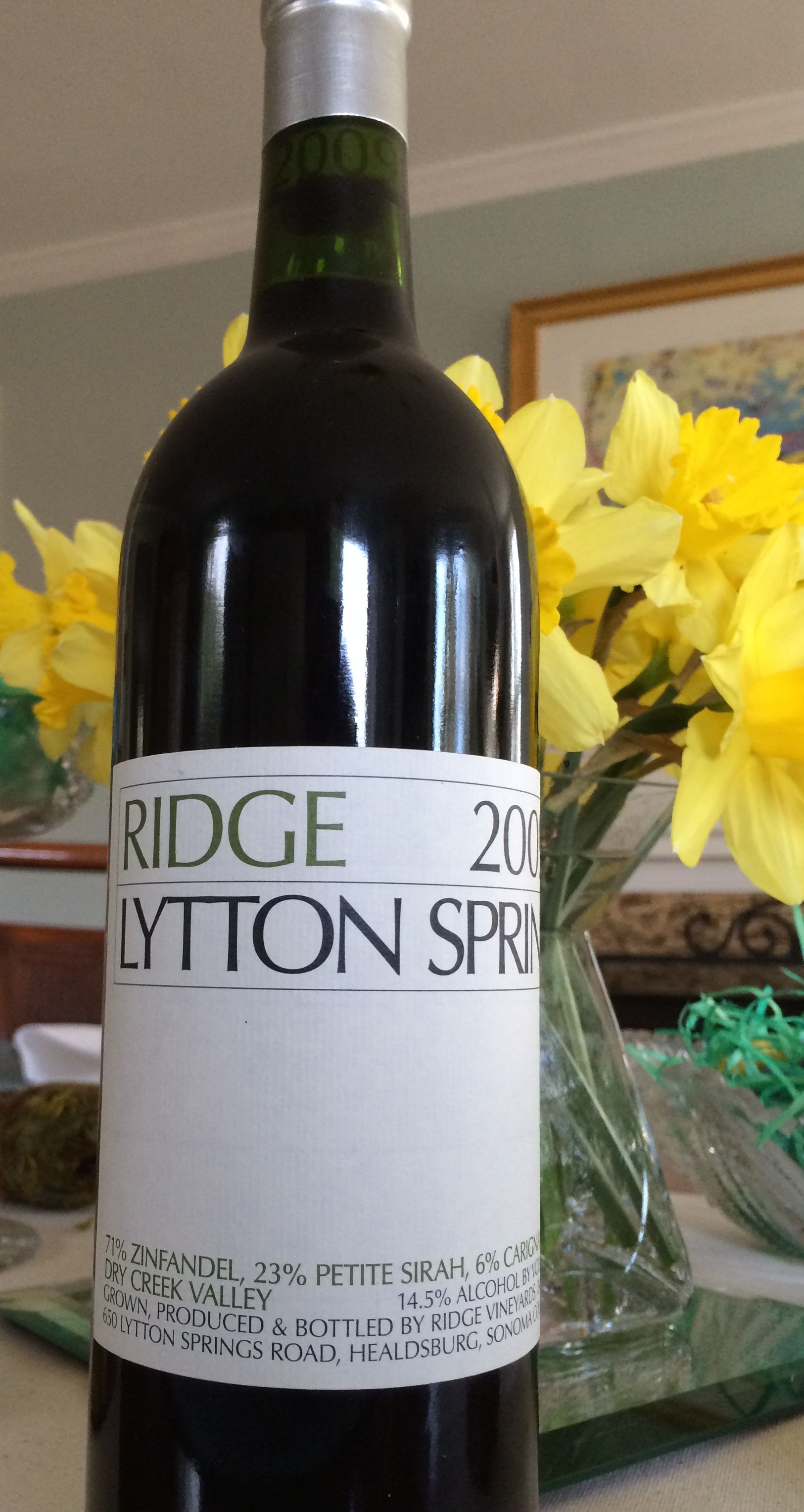
My other choice to complement the recipe is zinfandel. I’m recommending a medium-bodied and spicy zin with bright dark berry  flavors. The 2017 Ridge Lytton Springs ($45) will make an excellent pairing with the dish.

Wine Appreciation: keeping it simple

I know you’ve heard the term: “Harder than Chinese arithmetic,” right? Well, I’m here to tell you that wine appreciation doesn’t need to be that hard. Despite what some folks would like you to believe, it’s not necessary to have a degree in oenology, be a romance language expert or be wealthy to enjoy a glass or two of good wine.

For instance, some critics get way down in the weeds and use obtuse words to describe the sensory characteristics of wine. What, for example, do the terms precocious, unctuous or assertive have to do with the way a wine smells or tastes? Sometimes when I find myself slipping into what I call “snob-speak,” I harken back to an old Waylon Jennings song. In “Back to the Basics of Love, ” Waylon’s words give me swift rhetorical kick, knocking me off my high horse so I can explain in plain English the qualities of a particular wine.

So, when I describe a particular chardonnay as having ripe green apple flavors, you will immediately use your own memory of the taste, smell and texture of ripe green apples to understand how the wine might actually taste. If I wanted to be more specific, I could say that chardonnay also has the taste of ripe Honey Crisp apples. Well, you get the point.

In evaluating wine over the years, I have detected the flavors of blackberries, cherries, vanilla, cinnamon and countless others. And I have experienced the aromas of toast, grass, butterscotch and leather as well, unfortunately, as mold, Limburger cheese and vinegar too. These are descriptions that are based on solid sensory memories.

image

But what defines a good wine? Many of us struggle with another major consideration: price versus quality. Most of us assume there is a direct correlation between what you pay for a bottle and the way it should taste.

If you could afford to pay $100 or more for a “trophy” wine, wouldn’t you expect that bottle to be memorable? I had a friend who recently plunked down $150 for a bottle of Bordeaux that, indeed, was memorable, but for the wrong reasons. He described it as “rancid and musty.”

Since that description could fit any number of animate organisms, including cheese, old socks and/or a bevy of over-the-hill  politicians, my friend assured me that he was describing wine. The obvious lesson here is that expensive does not always equate to quality when it comes to buying wine.

Conversely, inexpensive wines are not always inferior. As a matter of fact, in my never-ending quest for excellent wine at bargain prices, I am often pleasantly surprised by the quality of wines I did not expect to be very good. The point here is that often our expectations are colored by the price of wine.

Here are a few tips when you’re looking for a good inexpensive bottle of wine. First, pick the wine that lists the grape varietal (i.e. cabernet sauvignon or zinfandel, etc.) on the label. Given the choice of choosing an inexpensive wine labeled as “Red” or “White,” or one described as chardonnay or merlot (for example), choose the one with the grape name.

Next, look for wines with a recent vintage date to insure freshness. With most inexpensive wines, producers concentrate on trying to make wines that exhibit bright fruit and freshness. Unfortunately, these are the flavor components that disappear first as most inexpensive wines age. This is particularly important with white wine which is more prone to losing fruit and freshness as it ages. My general rule (and remember, there are always exceptions) is to pick lower-priced whites with vintage dates no older than three years. With most inexpensive reds, vintage dates should be no older than four years.

There is another very important way to determine the quality of lower-priced wines. You should always try to select wines where the label indicates the specific origin of the grapes. For example, a 2018 merlot that indicates it was produced in Monterey County would be preferable to a 2018 merlot simply labeled as having been made in California. The more geographically specific the appellation of origin is on the label, the more likely the wine will be the better choice.

So that’s it for now, but in future columns, I’ll try to present you with more of the basics of wine appreciation. And a special shout–out to the late and great Waylon Jennings for reminding me to keep it simple.

John Brown is also a novelist. His latest book is “Augie’s World” which is a sequel to his debut novel, Augie’s War. You can find out more about his novels at wordsbyjohnbrown.com.

Thanksgiving 2020: Scaling back, but still celebrating

Thanksgiving is next Thursday! Under normal circumstances, our family would be gathering to stuff ourselves with all manner of goodies including, of course, a varied selection of wines to pair with – not only the “National Bird” – but with the multitude of delicious side dishes such as chestnut dressing and pumpkin pie.

But this year, Mother Nature has morphed into the “Wicked Witch of the Earth” with a dark and catastrophic menu of her own. She’s been conjuring up hurricanes, floods, wild fires and other global weather anomalies as side dishes to accompany the main course, Covid 19.

So, what can we do to celebrate Thanksgiving  this year, and still stay safe and virus free? Well, in our family that means limiting the number of guests at the holiday table to two: my wife and I. Oh, we’ll probably Face-Time with our kids and grandkids, but we will not be able to share food and wine or have any physical contact with them.


But the biggest problem for many of us in similar circumstances will be how to scale back on the Thanksgiving meal. Creating meals for two is not difficult under normal circumstances, but preparing the menu for the best food-centric holiday of them all will be a challenge, especially with regard to the main course – turkey.

image

I have tried, without success, to find a small turkey (under ten pounds) and there is just no availability. Apparently, the problem lies in the way commercial turkeys are grown and harvested. And this year, because of the pandemic, the demand for smaller turkeys greatly exceeds the supply. Among other issues, turkey farmers didn’t correctly anticipate the huge demand for smaller birds.

So this year, we’ll be oven-roasting a five pound boneless turkey breast instead of our normal 15 to 20 pound whole turkey. Even though we’ll miss sharing the holiday meal with our extended family, we will still enjoy the dinner- and the accompanying wines. And while I won’t limit the number of wine accompaniments with the meal, I will take more care in selecting them to match the more subtle flavors of the turkey breast .

In normal years, the beauty of using a whole turkey is that it is blessed with meat that has different flavors, colors and textures. And when you consider the manner in which the bird is cooked – from oven baking to grilling to deep frying or smoking – you can choose to use a great number of widely diverse types of wine from white to rose’ to purple monsters. But not this year. So, here’s my plan for this weird Thanksgiving Day.

I’ll submerge the turkey breast overnight in a brine of apple cider, beer, water and one cup each of kosher salt and brown sugar. On Thanksgiving Day, I’ll pat the turkey dry and then mix together one-half stick of (soft) butter, a teaspoon each of minced garlic, rosemary, cumin, black pepper and crushed sage leaves. Then I’ll rub the entire turkey breast with the mixture – even up under the skin – and bake it at 325 degrees until the internal temperature of the breast reaches 165 degrees (between two and three hours). I will allow the turkey to rest under tented aluminum foil for a half hour before serving.

I’ll use these three wines with Thanksgiving Dinner this year:

2020 Georges Duboeuf Beaujolais Nouveau ($17) – Beaujolais Nouveau is always a fun sipper full of fresh strawberry and cherry flavors. The first wine of the 2020 vintage arrives in wine shops this week and the Duboeuf is always one of my favorites. This is a great fruit forward celebratory aperitif to get you in the mood for the dinner to come.

2019 Kate Arnold Columbia Valley Riesling ($17) – Light and flinty, this dry riesling from the Columbia River Valley in Washington state has ripe apple nuances that should meld quite well with my herb and butter-rubbed turkey breast.

2018 Evesham Wood Pinot Noir Willamette Valley ($32) – This well-balanced pinot noir has bright cherry and spicy tea elements along with earthy notes that are subtle, but complex. This wine should complement the richness of the turkey breast and provide a little zing to the pairing.

Have a safe and Happy Thanksgiving!

John Brown is also a novelist. His latest book is “Augie’s World” which is a sequel to his debut novel, Augie’s War. You can find out more about his novels at wordsbyjohnbrown.com.